So, what exactly is Congregationalism?
Congregationalism originally came to the United States with the Pilgrims from England. Their interest in religious and personal freedom can be seen today in Fox River Congregational Church’s emphasis on Christ and the Bible’s teachings. At Fox River, we are an independent and self-governing church. From our founders, we inherited a wonderful spiritual heritage, one that is uniquely suited to our contemporary world.
Congregationalists possess the full liberty of conscience in interpreting the Gospel. As such, we are a diverse group of people united under Jesus Christ. We believe there is strength in diversity and unending opportunities to learn from each other and to grow in faith.

Our Mission

The Mission of Fox River Congregational Church is to fulfill Christ's Great Commandment (1) and Great Commission (2) to encourage, equip, and support all people in growing toward more Christ-like lives in their thoughts, feelings, and actions by:
- connecting with God in a loving and intimate relationship as modeled by Christ,
- connecting with Christian believers through love, caring and sharing life together,
- connecting with people through lovingly serving their physical, emotional, and spiritual needs, and
- connecting with people outside the faith through lovingly witnessing the good news of Christ and the power of God's love for all people, leading them to accept Christ as Lord and Savior, and bringing them into congregational life.
(1) Matthew 22:36-40
(2) Matthew 28:18-20
Our Covenant
- As a follower of Jesus Christ, the Son of God and my Lord and Savior, I covenant with God and other members of our church to personally commit to creating an environment for richer communion with God and to
- OWN the Mission of our Church
- GROW toward a more Christ-like life by seeking to connect with God in a loving and intimate relationship as modeled by Christ,
- Connect with Christian believers through love, caring, and sharing life together,
- Connect with all people through lovingly serving their physical, emotional and spiritual needs,
- Connect with people outside the faith through lovingly witnessing the good news of Christ and the power of God’s love for all people, leading them to accept Christ as Lord and Savior, and bringing them into congregational life.
- DEDICATE time, talent, and treasure to the service of God
- ABIDE in the Congregational Way as understood and embraced by our fellowship
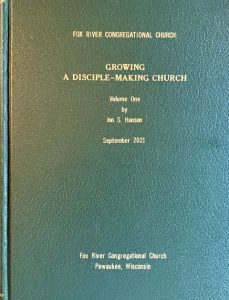
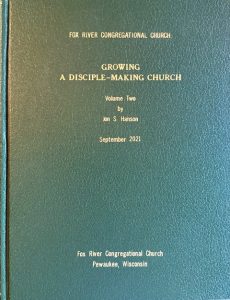
Growing a Disciple-Making Church, Written by Jon Hanson
Synopsis by Rev. Dr. Lonnie Richardson
This book offers a detailed blueprint for establishing and running a disciple-making church, with Fox River Congregational Church serving as the practical example. It starts by redefining church membership as more than just affiliation, highlighting that discipleship is the church’s main mission and clarifying what disciple-making involves. Then, it sets a foundation for mission: explaining why a clear, shared mission is essential, how distractions weaken it, and how a church can turn mission into a concrete purpose, process, covenant, and mission statement.
The heart of the book discusses each person's duty to grow and then details disciple-making through spiritual disciplines. It starts by highlighting the importance of connecting with God (prayer, Scripture, worship, solitude and silence, meditation, reflection, fasting, discerning God's will, and honoring different spiritual pathways), then emphasizes connecting with other believers (fellowship and small groups), serving as a discipline (including generosity), and reaching out to those outside the faith through evangelism.
After establishing content, the book outlines a step-by-step disciple-making process and how people typically move from conversion to worship, learning basics, developing personal disciplines, entering covenant membership, integrating into church life, joining small groups, growing in service, and learning to share Christ. It then expands each stage into practical program content, including transforming worship, teaching foundational faith, fostering spiritual disciplines, creating pathways for membership and assimilation, structuring relational and short-term small groups, and preparing people to serve and evangelize with detailed training approaches and various evangelism styles.
The final section emphasizes implementation: aligning mission, vision, model, and program; pursuing quality improvement; developing leadership and teams; designing systems to help people progress through the stages; evaluating both individual growth and church effectiveness; and organizing ministry structures and responsibilities. The appendices contain supporting documents, bibliography, congregational principles, Fox River Congregational Church’s vision and core values, self-assessments, tools, and governance materials.
Explore the Complete Volumes
Interested in learning more? Click on the cover of Volume One or Volume Two below to explore the complete content and related resources.